
Built to Endure: The Hynds Building and Its Next Chapter

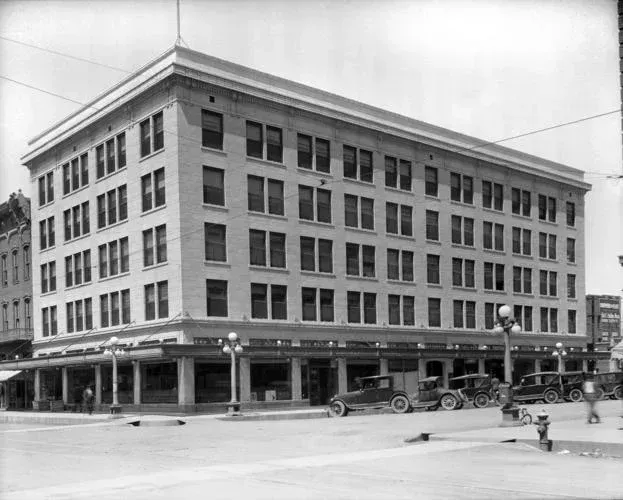
Recently, officials announced that the historic Hynds Building and the infamous “hole” next door have the potential to become a 69-unit affordable housing development called the Historic Hynds Lofts and The Reserves at the Hole. Just over $6 million was secured for this project through the Low-Income Housing Tax Credit equity, the HOME Investment Partnerships Program and the National Housing Trust Fund. You can read the full press release from the Wyoming Housing Development Authority here.
The History of the Hynds
Prior to the Hynds’ construction in the early 1920s, the Inter Ocean Hotel stood as a social hub on this prominent corner of Capitol Avenue. In 1916, a devastating fire destroyed the hotel, leaving behind rubble and a conspicuous gap in one of downtown’s most visible blocks. Much like the "hole" next door today.
When the owner of the Inter Ocean refused to rebuild it according to modern fire safety standards, the city stepped in. Cheyenne’s leaders, having witnessed too many devastating downtown fires, were increasingly serious about stricter building requirements. Rather than allow another vulnerable wooden structure to rise in its place, new expectations were set for safer, more permanent construction.
That refusal ultimately opened the door for a different vision.
Entrepreneur Harry P. Hynds purchased the property in 1917 with plans to construct something entirely new. He commissioned architect William R. Dubois to design what would become one of the most forward-thinking buildings in Cheyenne at the time.
Constructed between 1919 and 1922, the Hynds Building was built with a steel I-beam frame and reinforced concrete floors. It contained virtually no wood. Even decorative elements were made of metal, painted to resemble wood grain. After the destruction of the Inter Ocean, Hynds was determined to build something that would not burn.
And in 2004, when Mary’s Bake Shoppe burned next door — leaving what is now known simply as “the Hole” — the Hynds endured.
Hopes for the Future
After decades as an office building, the Hynds has stood largely vacant since 1985. In recent years, it has hosted a variety of art shows, classes, performances, and community gatherings. It has even been considered, at one point, for LCCC student housing.
While the Hynds Building carries more than a century of architectural and cultural significance, its potential future as affordable housing speaks directly to a very present need.
Across the country — and here in Wyoming — housing affordability has become an increasingly urgent issue:
- Nearly half of renter households nationwide are considered “cost burdened,” meaning they spend more than 30% of their income on housing (HUD).
- Workforce housing shortages affect teachers, healthcare workers, hospitality employees, and young professionals — a demographic Wyoming consistently seeks to retain.
- Construction costs have risen significantly in recent years, making it harder to build lower-priced units without public funding support.
- Downtown residential density has been shown to increase foot traffic and retail stability, supporting local restaurants, shops, and small businesses.
For Cheyenne specifically, adding 69 housing units in the heart of downtown would mean more than filling empty floors. It would mean:
- Lights on after 5 p.m.
- Daily customers for nearby businesses
- More consistent activity along Capitol Avenue
- A stronger case for continued downtown investment
This proposal not only preserves a building, it fills a literal and economic gap.
For more than a century, the Hynds Building has been part of Cheyenne’s story. Now, it may have the opportunity to serve the city in a new way.
If plans move forward, this historic corner of Capitol Avenue could once again be filled with everyday life as homes for members of our community.
#1 Properties: Helping Cheyenne find home and build community since 1984.